Wednesday, 28 March 2018

Good Friday Durian Party

Some of us will be having an impromptu durian party this Good Friday holiday. Durian at Hougang (Dennis' regular supplier.) :-)


Add caption

Did this poster after 13 confirmed going. ;-)

==== BELOW IS THE WRITE-UP AND PHOTOS OF THE EVENT THAT FOLLOWED====

As this Durian Party was held on Good Friday and the beginning of a long weekend, not all D10-ners could attend. Quite a few had prior holiday plans. And Danny was an 'if' as his mom was hospitalised after a fall. We wish Danny's mom a speedy recovery.

In the end, quite a turn out and rightly so. Durian this season is plentiful with plenty of good grades going at rock bottom prices. Plus the caveat was welcoming back newly found Willie Lim and back-from-India-posting, Alex Lim.

Ian Chiak was also a surprised last minute addition - flying in from Myanmar, making it the Shi San Tai Bao (十三太保) - literally, 13 Princes - of movie title of yore. (See poster above. I parodied it to 十三太饱, the last 'bao' being 'full'. So the title becames a funny, The 13 Full.

Thirteen who indicated they would come and attend this wonderful feast.

You could say my premonition was incredibly accurate as we were all quite full from durian AND porridge. Scary, sia.

Wefie (from left, clockwise): Willie, Alex, Dennis, TC, Ian Chiak, Khen Hua, Choon Meng, Ping Heng, Yew Meng
Karu, David, Barry

Above photo with Tiah Ann joining in later. Alex couldn't eat the durian as he was having a bad throat. Despite that, great of him to join us after recently returning from a work stint in India. Welcome back, bro!
We had quite a few boxes!
Dennis was the perfect host as usual, walking back and forth constantly asking after our preferences and checking if his fave vendor there had the respective kinds. In this way we managed to sample quite a variety of the spiky fruit, first christianed by famed naturalist Alfred Wallace in the mid-1800s when he went to Bukit Gombak to collect insect samples to send home to London, as the "King of Fruits". The durians we ate from Ah Wei (the stall vendor help) ranged from D13, maoshanwang, ang hei to small durians that held impossible fruit. It was like lifting your armpits and finding a sleeping bag there!

To those who could not make the trip, this could well be the regret of the year.

All the fruits we had were just ripe, fleshy, and with seeds so small that one could stick it up the nose! 
Best of all were the durians from Pahang, which had all the maoshanwang creaminess and musang king bitterness. The D13s were more for those with a sweet tooth, something Kheng Hua enjoyed and ordered.

However, with the good Pahang durians only arriving after 7 pm, Dennis had the good sense and consideration to order before hand. Thus those we had came in take-away plastic boxes cooled the night before in the fridge and thus were certainly less "jerlat" to consume. The warmer the durians, the creamier it gets... Just like milk.

At the end of the feast, Dennis also encouraged us to tapow as the durians were exceptional. (They were!) The whole affair was very generous of Dennis and grateful we all were. It is true of what Dennis says: "Got good stuff must share!" Now we just need to know what Dennis likes and pamper him some! (Pity there are not many fair-skinned women at Clarke's Airbase. Karu, pls take note!)


The soft, creamy, niam niam bitter taste durian from Pahang. If you have to eat one durian in a year, eat this. 

Ok, Willie had told me he was not going to eat durians at this feast, which was contrary to the whole idea of the gathering. But present he should be as the latest "foundling". So I offered him good ice cream instead.

The choice was Haagen Dazs. Good ice cream that's also easily available at the neighbourhood Giant supermart. It has been like that since Giant took over Shop 'n' Save.

The ice cream Willie had was Strawberry flavour. I chose this over chocolate as it was less heaty and also because I used to date a girl from the East who was crazy over this flavour. And so I came to like it as well. This flavour of Haagen Dazs has real strawberries in it and when chilled, tastes even better! It's light and a good pick-me-upper. It is the same with Jap Meiji strawberry ice cream.

In any case, if Willie could not finish his tub, he could always share with his significant female other later!


FYI: Giant Supermart is having a 2-for-1 deal right now. Three tubs for the price of two. So, not only are durians cheaper this season, ice cream too!


===PORRIDGE=== 

Sin Heng Kee Porridge address is:
Blk 685 Hougang Street 61, S(530685)
Hrs: 7 am - 9.30 pm Everyday 

Porridge: One-For-All, and All-for-One!  (And yes, it is the No.1 porridge that's best! If you liek tubes -aka intestines - order No.7 like Ian Chiak did.) 
Afterwards we adjoined to nearby Sin Heng Kee for excellent rural porridge. I didn't know that Hougang had such a famous boutique porridge place.


Tong and Kheng Hua went ahead to chope seats and place their take away orders, which proved a long queue (see pix above). We later discovered that eating there was faster than ordering tapow.

Sin Heng Kee is famous for their "No.1" porridge and so we ordered that. No.1 had fish, pork, liver, tubes, etc. It was indeed a belly-warming and heart-stirring recipe! Afterwards, we were seriously full both from durian and porridge. Ian Chiak, true to his liking for innards, ordered No.7, which had tubes (aka intestines), if I am not mistaken. In bak kut teh, he liked kidneys more than liver. (I mean he has told us how he liked to consume various wild meats, which in TCM terms, is not a bad diet to embrace.)


The tres excellente "No.1" porridge. Yew Meng kindly treated us to this. 
In the end, this event was a wonderful impromptu gathering to trade some jokes and indulge in some talkcock moments. Also a chance for us to meet newly-found Willie, who have had a tough week, what with his church founder, Rick Seaward, (formerly of Calvary Charismatic Church, now Victory Family Center) killed in an auto incident in Brazil. And today, having to attend his senior pastor mom's cremation service as well. A double whammy, and solid that he turned up at all!

=== JOKES ===


Karu also shared some jokes, two of which were medical:

Aye, Aye, Aye...

A guy goes to see his doctor: "Doctor doctor... Whenever I drink kopi or teh, my eye hurts. With Milo or Horlicks, nothing."

The doctor checks and finds one eye red. He gives the man eye drops and sends him home, none the wiser of what is wrong with the man.

"Let me know if it hurts again," is his parting advice.

The following week, the fellow returns with the same problem. This time his eye is redder still.

"Come, I'm leaving for lunch. Join me and we can talk about your condition at the nearby kopitiam."

There, the man orders kopi, one of his fave kopitiam drinks. The doctor sees this but doesn't say anything.

The man drinks.

"Ouch!' exclaims the man. Sure enough, his eye hurts again.

"John John John..." says the doctor, in a manner not unlike that of a patient parent.. "Next time when you drink kopi or teh, please remove the spoon first. It's poking your bloody eye out!"

=== Next salvo ===

Balls Out

A man goes to see you a doctor about a headache that refuses to go away. The doctor's prognosis is that the man has to have his balls cut off. "It will relieve the strain it is causing from the base of your spine to the top of your head," he counsels.

However, the man refuses to accept the suggestion, thinking how preposterous it was. He then decides to seek a second opinion. Then a third. All come back with the same advice: "Cut off the balls!"

Unable to bear his headache anymore, the man grudgingly agrees to have his balls cut off. To his amazement, the remedy worked and he could finally walk around with a smile on his face again. The scowl pulled long by his crusty balls gone for good.

One day he goes into a gentlemen store to look for underwear. He picks out the usual briefs and proceeds to pay for them. A senior service staff at the counter notices him. He looks him over and then at the briefs. He then says: "Sir, you know, right. If your briefs are too tight, you'll get a perpetual headache! I think you have picked briefs that are two sizes too small!"

At that, the man grabbed his rather empty crotch and wailed.

=== Alex back from India ===

A sample of domestic India plane.
After an almost 4-year stint in India, Alex of Murata Electronics Singapore shared this harrowing story of one time making a domestic flight.

The air-conditioning inside the small plane he was in - probably an ATR with that just one central aisle (see pix above) - was not working. Air inside was very warm and stiff. Alex put up a hand to check for airflow again, and found the vents to be extremely hot to touch. What's going on, he wondered.

Soon white smoke drifted over from the front of the plane as if to answer him. It wasn't an answer Alex was prepared for.

Neither the passengers too, it seemed.

According to Alex, no one panicked, everybody was calm. Or maybe the event was too shocking to comprehend.

I mean smoke filling up an aircraft cabin must be serious, right?

Yet the air stewardess moving through simply swatted at the smoke as if it was an everyday affair.

The smoke soon got thicker and alarmingly so. It shocked Alex. Is nobody seeing this? he wondered, not without thinking if his survival was at stake.

Could the engines be on fire? He asked his companion to peer out of the window to check. No fire. The props of the aircraft were still where they were and performing admirably.

Inside the cabin, the smoke continued to issue forth and build.

Er, shouldn't anyone say something?

Eventually, the captain of the plane did get on the intercom PA and announced that the aircraft's aircon had died. That they had in all probably 10 minutes left!

Alex told me he thought the captain meant the world was going to end in 10 minutes. But actually it was touchdown in ten minutes!

As you could imagine, 10 minutes in a smoke-filled cabin is very much like eternity in Limbo Land, you know, that place between Heaven and Hell after you'd died. So I could sympathise with Alex on how he must have felt at the time.

(If, in that interim, a buxomy stewardess were to approach me, then I would think I had ended up in heaven. It is in my bucket-list to expire in the arms of a double D lady with lashes so long butterfly kisses are like a Pharaoh's frond fan). If it was one of those very senior and bochap flight stewardesses from Qantas Air, I would know I was a bad boy and be sent to my room without dinner, durians, and the Internet. If it was a handsome air steward with a twitchy little finger, then I'd know it would be hell and I'll be buggered for the rest of end-time!)

In the end, even though the aircraft cabin was filled with smoke, the plane landed safely and did not catch fire. To Alex's relief.

Outside, he could see that the airport's fire services were all assembled and ready for action.

My, my, what drama and trauma to go through in a day's work!

==== Next ===

On another occasion, Alex spotted an emergency door that was clearly dented. He pointed that out to an air stewardess who simply shrugged the matter off. The plane took off just the same. So domestic air travel in India is not for the faint-hearted. *Sweat

I am wondering if people clung to the outside of the plane just as they would trains in India.

Just two of the many stories from today's Durian Party and talkcock session. Plenty more for the next round. Cheerio guys, and keep well till then.

A loose screw could make a lug loose as well. So tighten your watch screws from time to time and maybe apply super glue to prevent them from coming off. Super glue can be dissolved with nail polish remover.
This gathering was also a good time to repair the D10 watches of Barry and Ian Chiak as Dennis had brought along spare screws and a couple of extra new watches. The D10 watch is well-made and definitely value for money at $120, but its screws and lugs could become lose after prolonged use. So some regular maintenance is needed to prevent both the lugs and lug screws from falling away.

(This Panerai lug design is actually very convenient for changing straps. No fidgeting with springloaded pins, etc.)

Two new watches were passed to Willie and Alex. Guys, welcome to D10 Timekeeping! What is D10 Timekeeping? I would like to think it is looking forward to the next talkcock session. *Big smile!

Meanwhile, keep ticking and prospering, bros. Not waistline, just anything but. And Happy Hols!


=== Liaw and His Cadet Tee ====

Oh, if you look closely at the above gathering photos, you might be able to glimpse Liaw wearing his OCS cadet tee. The very one with the OCS badge and red and orange shoulder stripes. Man, amazing how he could still fit into that tee-shirt and eat all that durians and porridge, haha. Zhan!
Liaw wore the same OCS tee (as shown here on Seto) to the Durian Feast. Fantastic! Should have taken a clear shot of him in it!

- TAMAT.

Saturday, 24 March 2018

Finally, the Last D10 Member is Found!


Today is a HUGE day in our D10 Reconnection journey.


The final missing member of our platoon is located and importantly, rejoined.

He is none other than our very own Willie Lim.

I remember him back in OCS as a devout Christian, always bible in hand outside the corridors of our OCS barrack. He was taller and bigger sized than me and it was always great to have him help out in weapons carry, bashing through jungle, etc. He was always cheerful (no doubt aided by a positive Christian outlook) and gung-ho; a demeanor that often brought levity to an otherwise serious platoon proceeding, especially during mission topos and training overseas.

He also had his own way of thinking and that often made our PC Ang say: "Lim Willie... Must be different!"

Whether he was quirky or into his own Christian world, it was never a doubt that Willie was a good chap to have about. He as also pretty sportive.

I recall sparring him in the boxing ring. It always felt a challenge as he was bigger and rather bullish. A good thing I took karate-do in my teens and thus was not so easily put-off.

I think in boxing we all took away some important personal lessons. But the one thing we all can agree on is how tired our arms would become, often hanging limp by our sides after each training session. Our triceps were certainly still soft as tofu during those fresh NS years.

Finding him.

I knew he was devout - and from SAJC - so my first search was if he had become a senior member of a church.

I made calls to SAJC but they were fruitless, as were searches on the Internet.

How about Facebook? As a resource it was useless. There were just tens of Willie Lims...many not anointed with a profile photo. So, how to identify if any were our Willie Lim? Of course at times I would send a Messenger message to enquire. Thus far, no replies.

After each failure to find him, I would take a break and hope something of him would appear in a Google search later. (Hopefully good news!)

I would also wonder each time I came across a Christian organisation, if Willie Lim belonged to it.

This happened one time when I passed by a Family Victory Centre near my place. I thought about it but left it at that.

Then last week, I came across a flyer from VFC. The thought of Willie's association returned and I sat down to do a Google search. I used the keywords: Willie Lim, 55

A search result with Willie Lim's name finally turned up. It listed him as a volunteer at an VFC outlet. Could it be him? Well, it was a week-day morning so I put a call to the VFC HQ. Turns out there was a Willie Lim but he was helping out at a VFC pre-school. I made some inquiries and left my number. Days passed and I forgot all about the matter.

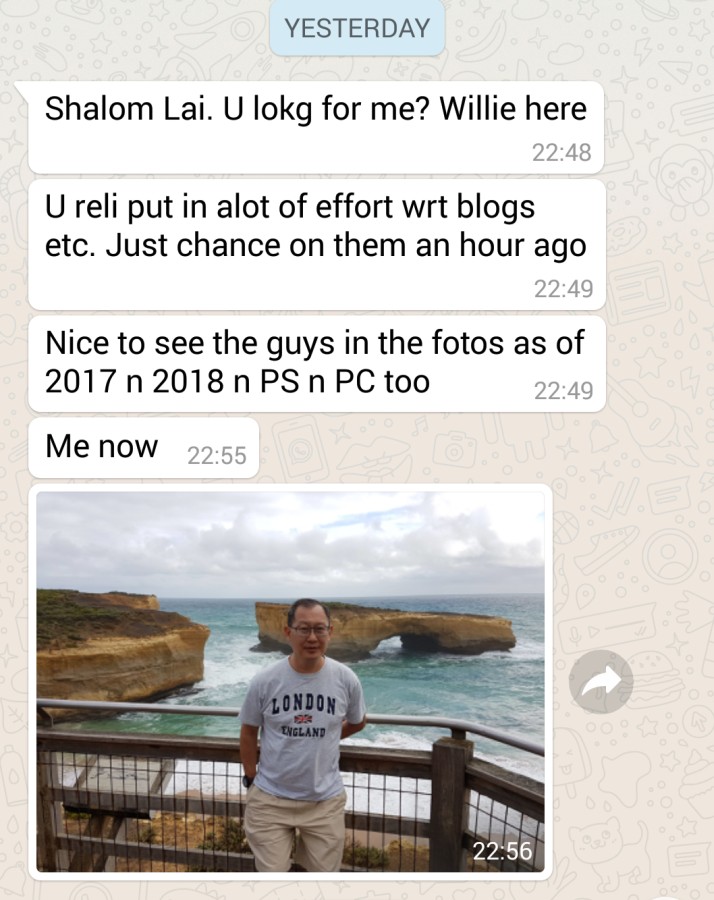
So imagine my surprise when just the other night (Friday), I checked my phone at about 1 am+ and received the following text:

.

It was like seeing something really amazing... a lost locket or special childhood toy! And he had seen our D10 blogs!

(By this time, I had completely forgotten all about me calling VFC and trying to locate him (such was the frequent disappointment of looking for folks). It had turned out that my reach-out to VFC was fruitful. And here he was, sending me messages and even a photo!

It is really nice when an old friend is willing to reconnect.

Apparently after Willie Lim learnt I was looking for him, he went and checked up on me on the Internet, trying to affirm if I was actually doing work for D10, not for some tax collector from the IRS or "dai yi long" (debt collector) from Geylang (haha).

So, it was a fantastic day for D10. For Chee Hwa, Willie was his buddy from BMT days. He was Tiah Ann's D10 buddy. I am sure his SAJC mates will be thrilled to re-acquaint with him.

So with this, the search for D10 mates officially comes to an end. With Willie found, it behooves folks like Adrian, Mooi and Ho Soon to finally find peace of mind and circumstance to reconnect with the rest of us at Platoon 10, Delta Coy, 1/82 IOCC. We wish them well and patiently await that day.

- Happy like bird! as they say, heheh. ;-)

84mm Life Firing. Willie there holding the dummy round. Me on the gun. Fun times. ;-)

Tuesday, 6 March 2018

The Taiwan Di Xia Jie Incident (1980s)


Background:

This was an interview done with Poh Ian Chiak on 24th Feb 2018 to find out more about the infamous di xia jie incident at Kaoshiung's notorious underground mall in the 1980s. Platoon 10 had their R&R there in 1982 as part of OCS training. In 1985, Ian Chiak was already a "regular" officer.

Ian Chiak:
Anyway, it should be the year 1985. 4 SIR went to ROC for High Noon brigade exercise and the normal battalion exercise, Starlight. It wasn't anything eventful until R&R. R&R was in Kaoshiung. Normally we would leave the place in two batches.

Half the battalion would come back one day earlier than the other. Just before the whole battalion left the night before, I was having a drink with my unit MO (medical officer) at a piano lounge. So we didn't know anything about the di xia jie incident until we returned to the hotel. What happened was some soldiers got injured and they called our hotel for the MO's room.

Once the MO got this notification, he called me. I was in my room and together, we went downstairs. At the time I was (supposed) to be the 106 commander. But in every exercise the 106 was undeployable, so I was pulled to become an infantry company 2IC. But the soldier involved in the incident was a 106 soldier. Or more precisely, the 106 platoon sergeant and his soldier; the two of them.

And so I was asked by the MO to go along to see the soldiers, who were already back at the hotel. Therefore, what I am about to describe is what was related to me, during my investigation into the matter. I wasn't physically there at di xia jie when the incident happened.

I wasn't the official investigating officer either, but I had to find out what happened. They were my men. The IO was usually someone higher up because this actually became a huge case.

So WHAT HAPPENED WAS about two to three soldiers - my 106 men - went into a shop.

But before they got in, the shop owner told them to leave their bags outside, that it was not allowed in the shop. That particular shop sold tee-shirts.

Tuck Chong: Isn't it strange to leave their bags outside?

IC: They (the Taiwanese) had their tricks.

So soldier is soldier. Cannot bring in so they left whatever bags they were carrying outside. They then went in and bought a few things. Some were there to look-see look-see, not buy anything.

When they walked out of the shop, the owner started accusing them of stealing/shoplifting.

Of course the soldiers denied the claims.

The owner then said: "Okay, let's search your bags."

True enough some tee-shirts with price tags still on were found in some of the bags left outside.

TC: So that was their trick.

IC: The soldiers then asked their platoon sergeant to go argue for them. The sergeant did just that. The shop owner then offered to settle: "If we don't report police can. But you got to pay me."

The soldiers then countered saying they would buy the items. But the shopkeeper refused. "That's different," he said. "If you buy, it is this price. Now you are caught stealing, it is this price. You have to pay so-and-so times more."

After this incident, we learned that that was not the only time our SAF soldiers were threatened or conned. It happened at a camera shop too and our boys ended up paying for an item three times the price. They used the same modus operandi. Leave the bags outside and later got accuse the soldiers of stealing.

But those few cases never blew up until this particular one.

In this case,  the shopkeeper went and called the police. But you know, the police were also their own people. I believed the police collected protection money from them.

About this time our unit cook happened to pass by. He's a bit of a character. You could tell. On his back was tattooed the whole image of Kuan Yin. After learning what happened he confronted the lead policeman there. "Don't talk so much," he said. "You want, pull your gun out.".

The policeman (hand on his holster) dared not.

Then the cook put his hand on the policeman's grip and dared him again to pull his gun out. The policeman again resisted.

The cook then took a chair and swung at him.

The policeman tried to block and broke a finger in the effort.

Then suddenly, very quickly, the local riot police was activated

Some of our officers were there and word quickly passed around that everybody should return to their hotels.

But you know, the di xia jie mall was very closed off and had only four entrances/exits. North, South, East, West... Or something like that.

When our soldiers tried to leave, the riot police were already at the exits. The police started hitting anyone trying to leave with their batons.

During this melee, someone had the sense to tell our boys to calm down and wait for higher-ups to arrive. You see, there was about half a battalion there. I mean in Kaoshiung back then, there weren't many places to go shopping. Di xia jie was THE place to go, much like our People's Park Complex in the past.

Our SAF liaison officer - the guy in charge of our training in Taiwan - flew down from Taipei to go visit the policeman who got injured.

But no one could keep the matter quiet. It all over the major newspapers the next day. Front page news.

"Starlight troop clashed with police riot squad," they read, or something like that.

It was that serious.

After the second day, when half the battalion had returned home, my S1 called me.

"Poh, I have something for you to do."

I knew what he was about to ask. I said, "Sir, I don't think it is a good idea!"

TC: Haha!


IC: He said, "Somebody got to do it!"

You know what he wanted me to do? He wanted me to bring a few commanders and go to di xia jie to recce and make sure our soldiers didn't go there.

I asked him why he didn't go himself.

I mean I am not going to go there and get whacked. I am not going to risk my life for that.

TC: Haha...

IC: So that was 1985. In 1986 when I went back to ROC as High Noon controller, we were told di xia jie was totally out of bounds.

There were two or three stages of planning in Kaoshiung.

After the incident, Kaoshiung was still the R&R place. But di xia jie was banned. Later the whole dang place got burned down.

TC: Burned down?

IC: Maybe business became bad and the owners burned the place to collect insurance money. Or the gangsters burned the place down in order to redevelop the land. But that's beside the point.

Later R&R went to Taichung.

I think Tainan first and then Taichung, or something like that.

I was a regular then and I was always called back during NUS holidays.

TC: Do you remember going to di xia jie as a cadet?

IC: I do

TC: I remember too. I didn't stay long. The place was pretty run down even then. Ceiling boards looking decrepit. Hey, your army regular life must have been pretty interesting. Did you go Thailand?

IC: No, that's more for the Guards. I'm pure infantry. Walk the road, charge the hill... that kind of thing.

TC: I remember my reservist was quite tough on the infantry as well. Always rushing from the FUP to the objective all the while walking at a brisk pace along river banks full of pebbles. A lot of the men ended up getting blisters on their feet.

IC: That time High Noon was a very long journey. From Hengchun base all the way towards the north. Of course part of the journey was administrative. Not all areas along the area were suitable for training. But from the south to the northwards, I think we travelled some 100 km.

Ex High Noon was the biggest scale infantry exercise then. It involved two physical battalions and one skeleton with the brigade HQ.

For example, when 3 SIR went for their Starlight exercise and about to complete, 4 SIR would fly in. Then 3 and 4 SIR would combine and together, with 1 SIR skeleton, would start the High Noon exercise.

After completion, 3 SIR would fly back and 4 SIR would start their Starlight training.

I took part in High Noon in '85 as an exercise trooper; in '86 I went there as controller. 106 controller, as a matter of fact.

Because 106 was undeployable, I ended up as vehicle controller of the controllers' vehicles.

You see, when exercise starts, the controllers have to walk with the exercise troops (some 10-15 km). Someone had to look after their vehicles and bring them to the end point near the objective so the controllers could have their personal stuff back. To clean up, cook, etc.

I would end up staying at a local general's or retired colonel's house nearby or next to some provision shop.

So I often got to hear stories from some retired colonel or general, or like one time, sit beside a general's daughter whilst she played piano and together sang songs.

TC: That's not bad at all!

IC: Yes, that was in '86. Because in '85 I was with this battalion commander who quite liked me and so the next year when he became controller, he called me up and invited me to be the 106 commander, knowing there is nothing to command with the 106 outfit.

TC: Why was that so?

IC: The terrain was just not suitable/deployable. It is very funny because it was a known fact. Year in year out they still did the same thing, bring the 106 there.

TC: Were the guns there?

IC: Yes, the guns were always stored there.

TC: How were the Taiwanese involved?

IC: They only drove the troops, these "malao" drivers. So my job was to bring the vehicles from one place to the other. For 10-11 days at a stretch.

Along the way I could have stopped and gone for a sauna, haha. But I never did. You see, there's one day and a night of time to kill. It's always dawn attack dawn attack. So the troops would walk the night and do the dawn attack at about the time I would wake up, haha.

TC: Wah, you really "keok tiok".

IC: Haha, I don't need to eat combat ration; along the way there were all these shops...

TC: I like our training areas there actually. One day must go back there walk walk. The south is lovely.

IC: Now is different. The villagers attitude towards us has changed. Very different from '85 time. Now they don't hew you already. If you park your vehicle next to their shop, they will come out and chase you away. Last time, they welcomed you, especially High Noon.

TC: How come?

IC: You see, in the south, they already had the bad impression of us for many years. But in High Noon, we moved from the south all the way northwards almost to Taichung. The areas along the way had very little contact with us SAF soldiers before, so they welcomed us. But it later became the same when we go and spoil their vegetables, farmland, etc, etc.

TC: I wonder if they ever complained about us to their government

IC: Some of them were also very cunning. They themselves go and do something funny to their farm to claim compensation. Especially that part of the farm that's lousy or is bad already

TC: You regular for how long?

IC: Six years

My army life was more interesting during reservist.

During reservist I enjoyed myself. During admin meetings my CO would always tell his runner: "Don't buy beer for anybody else except Capt Poh." Haha...

TC: Why so special? (Haha)

IC: I dunno

TC: Ni de jiu liang hao (you good drinker). Drink can still function.

IC: But it was reservist what, you can behave a little different. When "active" cannot.

Especially defence exercise. CO, S3 come look for me cannot always find me. I got look-out mah. With 2 PDF, we were always talking about coastal defence, or some very spread out kind of operation. So they cannot claim they cannot find me. I could always be somewhere else, haha.

That's why I say my S2 was really intelligent. An intelligence officer that is actually intelligent.

Before he came to my training area, he would say, "You go buy a few cans of beer."

When he sees my runner or look-out he would tell him: "You go tell your OC I got beer for him."

I would then magically appear, haha.

TC: Haha

IC: You know, the old 2 PDF was actually located in Terror Camp our old ITD in Sembawang. The mess was not allowed to sell beer in the afternoon. But when my battalion goes there, they would. So after lunch I could go for one ot two glasses of beer before training.

It seems back then, I had a lot of special privileges when it came to beer.

Poh Ian Chiak - 2018

TC: Thanks, Poh, for the interview.

IC: No problem.

- The End

Tuesday, 27 February 2018

Catch-ups and Meet-ups

Below are some pics of us guys catching up when we can. Many of the pics are of guys picking up their D10 watch after the latest gathering on 2 Dec 2017 (those who couldn't make it). Way to go and what fantastic support!

5th Dec 2017: Phit Seng back to Perth and showing off his watch. Way to go, bro!
11th Dec 2017: Lunch with Kheng Hua, collecting his watch after coming back from overseas trip.
16th Dec 2017: Tiah Ann collecting his watch and sharing his army experience (a D10 interview).

20th Dec 2017: Lunch with Danny. Him collecting his watch. Way to go, bro! 

28th Dec 2017:  Bennett back to Ho Chi Minh and showing off his watch. 

30th Dec 2017: Catching up with Yew Meng, Huang Kiat and Chan Boon Kiong (back from China) collecting his watch Early breakfast at Ghim Moh Hawker Center.
2 Jan 2018: Chuan Hui showing his watch in office after getting it. Way to go, bro!
2nd Feb 2018: Meeting Siew Cheong for the very first time after all these years. Breakfast at Paya Lebar Square. 

9th Feb 2018: Catching up with Boon Teck (Teddy) for dinner in Sembawang.

15th Fb 2018: Kok Kee delivering my fruit cake order from his baker. Wow, thanks bro, for following up on that, and the treat!
15th Feb 2018: Hung Kiat catching up with Kian Meng at BMW workshop. 

18th Feb 2018: Catching up with Eddie in Sembawang, he collecting his watch. Posted to Shanghai, back for CNY hols. Way to go, bro!
24th Feb 2018: Lumch with Ian Chiak (back from Myanmar for CNY). Trying out his friend's BKT stall at the new Yishun Park Hawker Centre. Very good garlic, ginko nut flavour. Had a very good seafood white beehoon there as well. Also a chance to hear Ian Chiak's retelling of Taiwan reservist "di xia jie incident".
28th Feb 2018: Great of Choong Seng to call on me during a brief stopover in Sg. He was also here to do his annual check-up with his doc at Mt E. Still busy with his work in China when here. Don't forget to relax, bro.

6th March 2018: SAFTI Alumni Dinner at new Temasek Club (Rifle Range Road). Kheng Hua, Choon Meng and myself. Unfortunately, Dennis and Yew Meng couldn't join in. Maj Ang Tow Hai was there. 
=====

Earlier meet-ups and catch-ups:

29th Jun 2017: Meet-up and send-off drinking session for Ian Chiak. Going to Myanmar to work as IT security consultant.
30th Jun 2017: 2nd send-off for Ian Chiak at Island Country Club. Huang Kiat host. Thanks, Dennis. ;-)
1st Jul 2017: Johnny with Golf Company cadet B Spears (LOL) @ Marina Bay Sands
26th Jul 2017: Poh training in Ho Chi Minh and catching up with Bennett there. Bennett runs a pre-school there and commute back and forth Sg often.
17th Aug 2017: Famous Paper Wrap Chicken restaurant along Clementi Road closing down. One last burst of fire, haha. Host: Tong Ping Heng (friend of proprietor son. Form NYJC?); Dennis brought durians!
30th Sept 2017: D10 Gathering Org Comm meeting at American Club Chinese restaurant (Scotts Road). Very good glass charsiew! Present were Dennis, Tong Ping Heng, Lim Yew Meng, Liaw Choon Meng and myself, TC Lai. Dennis host. Thanks, Dennis! ;-)

30th March 2018: Durian Party at Blk 682 Hougang Ave 4. Host and treater Dennis at his fave durian supplier stall. From left, clockwise: Willie, Alex, Dennis, TC, Ian Chiak, Kheng Hua, Choon Meng, Ping Heng, Yew Meng, Karu, David, Tiah Ann, Barry.
30th March 2018: Same day as Durian Party. After durians, adjoined to nearby famous Hougang porridge shop Sin Heng Kee. Superb porridge. Yew Meng's treat. 


=====


Thursday, 7 December 2017

Profile: Our PC Maj Ang


Major Ang Tow Hai
DoB: 7 Mar 1955 Age: 62 (2017)
Zodiac: Goat, Pisces
Status: Married, two boys; Retired Mar 2017, after 18 yrs  at MOE;
Background: 41 SAR, 1979: Amour Infantry Officer Adv Course; 1980: OCS PC

A D10 profile interview with Maj Ang, our PC during OCS. Interview done on 30th Nov 2017, 1600hrs JCube. This is the beginning of a series to profile everyone from D10. 

1. How did you end up in OCS as PC?

I was in the Armour formation when OCS started to revamp the SMC (standard military course), revising the Junior and Senior terms, and starting BMT at ITD.  It also introduced leadership selection through a series of tests to pick the cadets. Previously, there was none. The new OCS setup - the IOCC - needed many new instructors and so I was recruited.

I had just finished the Armour Infantry Officer Advanced Course at the time. 

As new OCS instructors, we had to undergo a one-month orientation course. We went through all the newly planned exercises future IOCC cadets were expected to go through. That was in 1980. The defensive, offensive, special ops exercise, etc....we all went through. Including the training areas.

We also engaged in cadet character development and sportsmanship activities such as rugby and boxing; - Stuff we never tried before ourselves, haha. Boxing ourselves left right centre!

TC: At least you guys were already men!

Yes, I was 25 years old at the time. We were all young and tough. And the typical 18-year old cadets we get were garang, fit and willing to cheong.

2. Why was there a need to change the SMC?

At the time the SMC had gone through, I think, 11 batches. Importantly, they felt the need to keep the BMT separate, i.e. ITD and SBMT, to better help identify the potential OCS candidates. This was done through a series of situation or initiative tests. Previously, the cadets were selected based on their ECA, i.e. if you were a captain of a team, chairman of a club, etc. This did not prove very effective. So they decided on this three-month BMT to give every enlistee a chance to prove themselves. There were five stations of situation tests including open discussions in the field. It was then followed by an interview and a psychomotor test.

In this way, OCS managed to cut down on the Junior Term attrition rate which became very low. Fall-out was mostly due to a physical inability to cope.

So we had the IOCC and now the five-service phase and then the two-arms one.

3. Among us D10, you were famous for your "Don't make me lose face" mantra. It was pretty unusual then. I mean what were your thoughts on leadership at the time?

Leadership by example... Something I learned from being in Armour. Being able to do what you expect from your men. But leadership is more. Being able to plan, lead and come up with a logical solution. And at the same time, be flexible enough to do adjustment to the situation on hand. Also as a leader, you must have the respect and support of your men, not through rank position but by winning their hearts. When given a leadership role, lead and be decisive. You cannot be hesitant and infirm.  

4. What made you let your cadets manage themselves?

The cadets are the future officers. We give them minimum guidance, the rest we leave to them. Because in the future, they have to manage their own soldiers. The nine-month course is their learning phase. Let the cadets learn amongst themselves, then analyse, see what is the problem and learn not to make the same mistakes again. Because once you become an officer, you cannot be making mistakes.

So being an officer cadet is the best time to be given ample opportunity to lead, to plan, to execute and to debrief. Know what went right or wrong, and then improve on it. At the end of the day, everybody learns and picks up something.

This helps very much when you become a platoon commander. To a certain extent, we instructors already know.

So it cannot be everything we give you command and you cadets just follow. You will learn nothing.

When you are training officer cadets it is a different story. So we want the cadet to lead. 

5. But you do agree that your method was very different from the others at the time?

Yes. I wanted you cadets to lead and manage yourselves more. But we did observe and intervened when necessary especially when it came to safety. It was as important then as now. We don't want cadets injuring themselves and not complete the course.

So only when something is not right, I will intervene, discuss and carry on.

6. What did the school's Chief Instructor had to say about all that?

We of course followed what the CI wanted. This was especially so during the excise planning phase where every cadet is expected to participate, learn as a future platoon commander. So everybody plans and afterwards someone will present the plan and everybody critiques. 

This is before the field appointment was given.

If someone thinks he has a better plan - one that is tactically sound - he can present his. We then select who has the best plan and then will only field appointments be given out. PC, PS and section commander.

And then come time to present the ops order which is another learning phase. Because as a platoon commander you need to let your men know the operational aspects of a mission.

7. How were exercises developed during our time?

Oh, in the OCS HQ there's the Senior Instructor who will be doing the planning. Where the offensive location is, the movement by day or night, the live firing, who is in-charge, etc. They come up with the lesson plan, exercise file, location recce, etc. We as PCs go through all the exercises during our one-month prep-course. 

And during execution, the SI is on hand to give advice, provide guidance. For example, in a night attack, say, from Sembawang 4-track junction to Hill 265 objective, with Frangipani Hill as firebase. So we select the route of movement, plant the enemy simulators and encounters along the way and see how the cadet platoon commander react. 

Before that, the day and night recce. And once the night attack is on, withdraw, reorg and casualty evacuation, etc.

8. During our time, we were still under the Instructor Team system.

Yes, the teams would run the exercises and specialise on them. You have the Offensive and Defensive Ops, Brunei, Tekong, Navec, Watermanship, etc.

As PCs, we also follow the exercises to make sure our cadets are properly handled, instructed, etc. So we would take a section (different sections) such as in a navec exercise. Not just sit and wait at the end point. In this way we get to know all the cadets well. Their strengths and weak points and how we can help. We don't want them to be demoralised.

I cannot just base on instructor feedback. Not accurate.

9. Were you also not very concerned about overseas training?

Yes. Overseas training are often summary exercises and are usually eye-openers. Best way to do an exercise realistically. Go the actual distance. Both Tekong and Ubin very small. For example in Brunei jungle training, when you come across an obstacle, it is real. A river that you have to actually river-cross.

Then there's the navec exercises. Real planning in the jungle day and night and accepting the weather there. So both physical and mental challenge. Also navec challenge as the terrain is new/unknown. As cadet platoon commander, it exercises your leadership, planning, and challenges your command and control. Also motivation that sort of thing. So in Sg you learn and in Brunei, a summary exercise to reinforce all that prior learning. You cannot simulate that in Mandai, which is very small by comparison. But Mandai is still a good place for training... basic training like close-terrain navec. Navec a few kilometres in which you must find the checkpoint and logpoint. You lost in Mandai we can still find you; in Brunei, still can but we will take a longer time (haha). So we are more serious about it.

10. In Taiwan wasn't there a lot of trouble with the farmers?

Actually they were very supportive. This was because the farmers in Bengtong area, Henchun (where we trained) were very supportive of their own army back in the early '80s. Their goodwill extended to us.

Although we were Starlight troop, they also considered us as "ah bing ge" (brother soldier). In fact they helped us a lot, such as refilling our water resources when needed. They were very supportive and did not give any problem. Plus our training areas were mostly out of their agricultural areas, so there wasn't any conflict. 

Even our live firing at Highway 199 cher lui li or defence exercise and other SAF training areas...they were ok. We only worried that after live firing they would go there and pick up empty cartridges (as scrap).

For Armour our living firing was at Houkou in the north. In the south, armour infantry cooperation exercises. Tanks moving along the Baoli river and the Badi san doing live firing.

11. Have you ever brought a troop of Hokkien peng to Taiwan to train?

Yes, but during my Armour time. Our infantry trooper at the time was like the infantry rifleman, education level low. Primary six, or at most Sec 1 or 2. But they were good soldiers making up infantry trooper, GPMG gunner, M113 driver, etc. In fact they cooperated very well. We had battalion proficiency tests so their mustering of the weapons they had to be well learnt and be good at. They all cooperated very well.

12. Didn't our soldiers have quite a bit of trouble in Taiwan? 

Mostly due to cultural differences. Those who discipline/in-charge of the soldiers did't know the foreign culture. So sometimes these chaps go there drink and create trouble. At times they go shopping and bid for items at an auction and don't buy. Or bargain, argue the price for something but in the end don't buy. You as the seller also fed up.

But we tell the guys they represent Singapore, so they have to behave. We also tell them to avoid certain areas such as seaman clubs, pubs, those sort of places. There were gangsters then also. They operate in certain areas with drugs, etc.

Then there's the famous di xia jie - underground shopping complex. They have auction sales there too. "Camera, camera, NT1000 only!". They show you the real one but after they take your money, they slip you a dummy set. So argument, fight.

13. How many times were you in Kaohsiung?

Four times as officer. Fave spot? Night market at liu he hu (Sixth Harmony Street?) A lot of good memories and good food. A fave spot with everybody including our cadets as well. 
  
TC: A key memory for me was my brother telling me to go to a certain bookshop to shop for university texts. He said the engineering texts there were cheap. Printed on jotter and bounded in hardcover.

Ang: Yes, there were certain big bookshops that sold pirated copies of expensive texts - cheap and good, such as those for engineering, medical and architecture. Now the popular one is a 24-hr joint called chen ping

So when you go Taiwan for training, there's some reward.  You know where to go, where to shop, buy dried longans and other certain special souvenirs, etc. Good food, western meals, and of course, mu gua niu nai.

14. What impressed you most about 1/82 IOCC?

The whole platoon everybody worked hard, fight in a friendly way. All very motivated, want to commission as officer. No one sabo-ed anybody.

Yes, the most impressive thing is we made history. Platoon 10 sapu-ed all the three top prizes of Sword of Honour, Best in Knowledge and Best in PT.

Sword of honour is not easy to come by. Contenders were quite strong. Put on mission, assessed by senior instructors. 

When Chan Boon Kiong won his SoH, it means he has the ability to receive that honor. There was a round of interview also.

As for Best in Knowledge and Best in PT, they personally must aim for it, be motivated for it. They have to push for it. But as an officer, all must have knowledge, good knowledge. With no knowledge, you cannot do training. Our carrot and stick is: less than 80%, confinement (haha).

So that one we little bit have to tekkan. There will be some who will never reach the mark, stay back in camp during the weekend to study. 

Certainly Tan Chuan Lee (Bennett) did very well. 

[Side note: Speaking with Chew Phit Seng the other day, I learned that Best Knowledge also included a range shoot. So if you had scored consistently well in all the tests but failed in that just one shoot, you can kiss your Best in Knowledge hopes bye-bye.]

15. You were well known amongst us for being glib in handing out "Take 1, take 2" (extras) whenever we cocked up, like falling asleep whilst digging trench.

Ah, yes I know OCS training can be physically and mentally tough. You mentioned defence where you travel under complete darkness and then start to dig. No matter how tired you are you have to complete by morning. A 12-hr plan. 

TC: In Taiwan I remember we had a tough time digging our trenches. By morning, not even reaching the knee. We broke so many tools.

Ang: Yes, that one was tough, all rocks, roots, etc. That was Baoli San near Highway 199. We had to bring up all the tools, mark out the arc of fires, etc. It was forward defence.

The later summary exercise at Highway 200 was better. Advance, kenna engaged, hold and then dig shellscrapes. The ground was definitely friendlier there. Nowadays we leave the trench digging to special forces (e.g. PDF), be more offensive in ops. Not waste time digging deep trenches.

Over in Sg we had Ex Lion and Ex Wolf, raid missions. Not sure if your batch had a tough summary exercise that night-navec from Seletar, land at Pramatang and secure the beachhead. Then navigate to FIBUA Village, attack and then withdraw. Helivac to Pulau Ubin, regroup, plan and mission again. Two nights three days, quite tough.

TC: I think our time, we ended at FIBUA Village, withdraw and waited for LST by seaside to come bring us home. 

Ang: Oh, then it was later that we expanded and developed that into an intensive exercise. Very challenging.

TC: Remember our platoon had Liaw Choon Meng the "Tekong expert?" He grew up on that island.

Ang: Oh, so we had an expert to help with night navec? Haha.

TC: I actually led that mission. Quite nervous as had to navigate at night over water and trying hard not to land the platoon in the wrong place. When we landed, we were crotch deep in mud. Whoever planned the exercise did not get the tide times right. Imagine having to trudge all that way on mission to FIBUA in all that mud. And the mud was stinky too!

Ang: Yes, it was very dark. Later we trained assault boat at Sarimbun instead of Seletar, night navec and land at where Raffles Country Club is at right now. Trudge in a swampy area, night movement, action in Area A. Quite tough.

16. Wasn't it already increasingly hard to do training in local areas?

No so bad because the schools always get priority. The battalions may have to shift a bit (make allowance) but when we call NS men back for training, schools such as OCS and SAFINCOS always are given priority. Because their period of training is fixed, they have to finish the course. It helps that we plan our exercises six months in advance. 

Now because of development and land appreciation, our training areas have shrunk but is still manageable. For big exercises though, we go overseas to Australia and Thailand. Even India.

In Australia at Rockhampton in Queensland, we do tank exercises up to brigade level, salt-water based. The next phase of development will be further north at Townsville, now in discussion with the local townsfolk. It will be for an area four times that of Singapore. At Rockampton the training ground is five times the size of Singapore.

Because objectives are now three days away or so, infantry soldiers cannot walk there, they will lambek. They all use the Terrex.

TC: Yes, I remember reservist training in Taiwan where we walked or force marched for 5 km walking along dry river beds and ending up with blisters.

17. What are the most common complaints from cadets?

Well, most of the cadets are officer capable. They never complain that the training is too tough. But we know that training is intensive. Like during lecture they doze off. After night topo no rest and just carry on, attend lecture. No such thing as rest. Even when you are doing guard duty. You just finish and continue.

That is why we have compulsory 11pm night's off. But at times people carry on when there's a test coming. Understandable.

Most important attribute in an officer or cadet is their ability to plan. And command and control. Ability to stay calm and cool in a critical situation. It is sad to see a decent person fail in this. They become kancheong, karang kabut don't know what to do. As a commander you have to direct your subordinates, not say "You carry on, I don't know what to do."

You have to say, for example, "Stop. Evacuate casualty, etc." Command and control.

18. How were cadets assessed, final decision made? There was also peer-to-peer assessment.

Peer-to-peer assessment?

It is quite common. It reflects a part of the cadet we cannot see. He may appear helpful, etc., to us. But if his buddies say he is bullshitting, kwai lun, etc. this peer-to-peer assessment will reveal. We don't take it 100% but it is actually quite accurate.  

The final decision depends on exercise performance, mission planning and change management, application of knowledge, whether application is sound or not, test results, etc. The Tactics Team instructors also weigh in. Because they don't know you, they give a very neutral picture.

19. So comparing both the Mentor and Tactics Team systems?

Actually both systems work. It is the quality of candidates that come to OCS. But if you ask for my personal preference, I prefer the Mentor system where every section has a dedicated instructor. As long as good instructor and all-rounder and if he's as an officer who can always improve himself.

With a mentor, there's continuation. With each exercise there's discussion about execution and assessment. There's better understanding. At least more consistent, no disruption. So I rather have mentors in each section under my control. Bonding can also develop within the platoon and cadets.

[Side note: In D10, those who were retained to be instructors in OCS were the school's first mentors in the new Mentor System in 1983, when the old Tactics Team system was abolished. Folks like Karam Singh, Gerard Lee, etc., were pioneers of this new system (joining Maj Ang's D10 platoon). I was going through the Mentor instructor prep course with them when I was yanked out mid-way to be converted to Pnr Infantry Officer (at Gillman Camp) so I could return to teach Demolition in OCS, joining the only team left in OCS: the Demo & Weapons Team. Our seniors were RODing and needed fresh blood. Only I and fellow instructor Fong Haw Tien (Foxtrot) were crazy enough to volunteer. (The refrain we often got from others was: "It's only NS. Why risk your life with explosives?" The reason was that Fong and I didn't want to babysit cadets and go through the dang 9-months all over again! ;-) We valued the autonomy a Team gave. I think Fong and I brought something different to Demo training. Because we weren't the kiasu types, the cadets we trained became savvy with explosives. Not handle all like fragile eggs!] 

20. Has any platoon matched the 3-in-1 achievement of D10 so far?

As far as I know, I don't think so. Maybe a prize here or a prize there but never all three again. One award only. So we are very proud of what we have achieved.

21. In Delta we had the scholar platoons of 11 and 12? They were competitive, no?

Oh, only Platoon 11 was scholar. Platoon 12 no. They only had those foreign Bruneian cadets. Platoon 11 scholars disrupt during Senior Term in September and then become smaller.

Eric Khoo became Commando colonel.

22. So, in total, how many OCS batches did you take?

Four. '80, '81, '82, '83. 

In '80 I was in Bravo company. After Junior Term I handed over to Maj Ng Heng. A bit reluctant because I've already established a kind of bonding and friendship. Then was asked to go Echo. In this way I gained experience before going to Delta. So, no problem, everything at fingertips.

I got a 1981 cadet Lim Teck Yin become a BG (brigadier general). He's CEO of Sg Sports Council now. Another BG from our time is Ishak Ismail from Platoon 12. 

I still remember I organised the Cadet Commission Ball with him at the Dynasty Hotel. Do you still remember? I think you forget already!

TC: No, haha. I still recall the suit I have. A muted Royal Blue one with black threading. Made from that excellent Brazil Tailor shop in Bukit Timah Shopping Centre. He has since moved to Beauty World Plaza. Still there when I went there earlier this year to eat that excellent Thai burger from the rooftop hawker centre.

Ang: Ishak at the time was posted to 3 SIR. We couldn't get the date we want and were given a Sunday. Not so ideal as the next day is a working day. And you know, it was a D&D.

TC: Dynasty Hotel was quite new then, wasn't it?

Ang: Yes, quite new. We had Chief of Defence Force Winston Choo as guest of honor. It was funny that night because we gave the wrong signal and everybody stood up expecting him. We had to tell everybody, "Rehearsal, rehearsal...". haha.

23. What did you do after leaving OCS in 1984?

I went back to 41 SAR to become combat team OC. Stayed there for two years till 1985 and became a trainer at the Armour Reserve Training Centre. Now we call ATI or Armour Training Institute. Training NSmen, local and overseas. So I know a lot of NSmen.

One of them is famous lawyer Peter Cuthbert Low. He was recently given an award (the CC Tan Award for exemplary lawyers). We trained in Thailand. He was one of the battalion COs. 406 SAR, I still remember.

After that I worked in HQ Armour as a trainer and assistant training Ops Officer. This was up till 1990 and then went back to ATI. 

In 1992 I was selected to for a UN mission to Angola. It was under the UNAVEM - United Nations Angola Verification Mission. Our role was as observer for their elections. Before going, we had prep training. 

We stationed there from 8th April 1992 till 30th Nov same year - almost nine months.

At the time my eldest son was only 7 years old, his brother two and a half. It was tough on my family. Communications in Angola was not very advanced at the time, so we wrote letters. But as a regular, as a professional solider we go when we are asked. I took it as a challenge, in the right spirit. My wife was supportive also, even though she knew it was dangerous at the time in Angola. There was civil war, a temporary ceasefire to allow for UN supervised elections.

But it failed and they went back to fighting again.

It was an experience to see a war-torn country. Everything so run down, no proper schools and healthcare, weapons all over the place. It was very terrible, very unstable.

But it is now stable and advanced, thanks to Chinese investment. The Chinese government is quite influential there.

After Angola, I returned to Armour training school and later to 2 PDF as Ops Officer providing Armour support, island defence. This was from '96 to '98. So once again I trained NSmen.

End of '98, an opportunity opened in MOE as an Ops Manager, and so I applied. It was time to leave the Army. I was at age 44 then. 

I served with MOE for 18 years and only retired this year in March. I was all along with Jurong Secondary School. This job was kind of the same thing between soldiers and students. We teach them, care for them, etc.

24. What made you decide to be a regular soldier?

Basically, when I was young I lived in the Lim Chu Kang/Ama Keng area. There were the British soldiers doing deployment with armour vehicles. As a small kid, we were curious how they went about their business. And they often deployed in a rubber plantation in Ama Keng. 

So I found armour vehicles quite interesting. When in NS I became an officer, I decided to sign on and take up the vocation. 

TC: Were there any objections from your parents?

Ang: No. But of course at the time, the career advancement path was not clear, was slow, etc. 

25. I recall during our time in the early part of the 1980s, there were many changes happening in the SAF.

Yes. In terms of thinking, equipment and man-management. 1980 onwards, the SAF manpower system was revamped to attract more talent to the Forces. Changes to the non-commissioned officer ranks and career path is one example. 1981, there was a salary revision even.

26. I don't recall many incidents during my time with D10.

No, there were no major incidents with D10 apart from the usual falling sick cases, etc.

TC: There was that bee sting incident on Tekong?

Ang: Yes, that's why we emphasize on safety. But one time it was a cadet who did not know what to do. Instead of thowing smoke and covering himself with a groundsheet, he threw smoke and cover himself with the smoke grenade inside. So he suffered allergy due to smoke inhalation. But he was ok, no lasting damage.

TC: I remember we did river crossing in Brunei and then hurried at a fast pace to a harbouring site as it was getting late and really dark. However, and surprisingly, no one sprained an ankle getting there. We slept in the open, could see stars above. At night I could hear deadfall by the perimeter and was glad you and Karu brought us to the open. The falling deadfall could have injured someone badly. 

Ang: Yes, we deliberately harboured on the rdige. Deadfall is serious. An officer died because of that. 

TC: My girlfriends used to ask me if NS was safe. I usually tell them...because of my D10 experience... ok lah. 

Ang: It's safe. It's even better now. Lightning warning, everybody go hide in a tonner or training shed. Last time mana ada. Thunderstorm is best cover for element of surprise. We still carry on and attack.

But now no choice. We don't want unnecessary injuries.

TC: Families also have only one or two precious kids.

Ang: Same thing with handling of weapons during live firing, etc. We were very strict then and now. Same thing with driving with SAF licence, etc.

27. So you grew up in Ama Keng? Which school did you go to? (Personally I have quite a few friends from this area)

Kay Wah Primary School. I really appreciate that group of farmers and businessmen who came together to start this primary school before WWII to educate the farmers' daughters sons. Kay Wah school branch in Ama Keng was a wooden building with only six to eight classrooms. They even used the wayang stage as a classroom. Even in 1962, no light no electricty.

I think if they didn't start this school, quite a few people would have remained illiterate, stayed as farmers or odd-job worker.

For secondary education, I went to Bukit Panjang Govt High.

TC: A good school as I recall. I studied in nearby Boys Town's Assumption English

Ang: During that time schools all same. I could have gone to Hwa Chong but that was too far. Any Chinese school, so no problem.

Kay Wah had a few branches. Two in Neo Tiew, a third in Ama Keng and the main one in Thong Hoe.

TC: Maj Ang, thank you kindly for speaking with me.
Ang: My pleasure. I think it is wonderful what you are doing.

Note: Our PC Maj Ang will be spending the second year of his retirement travelling. Next year, he and a gang of friends will be in the US on a road trip to cover all the national parks. Quite an undertaking, I would imagine. We wish him a safe journey and lots of precious memories to bring home.

- The End